What Ayurveda practice management software does for your clinic
Most Ayurvedic clinics start with case sheets, a register and a WhatsApp group. It works while there is one vaidya and a handful of patients a day. Then the courses start to overlap. Nobody is sure whether today is day five or day six of a patient's Panchakarma, which therapist did yesterday's Abhyanga, how much of the course was paid for, or how many bottles of a taila are left on the shelf.
Ayurveda practice management software keeps all of that in one record per patient. When a patient walks in, the front desk sees today's appointment, any course they are on and what is owed. When the doctor opens their file, every consultation and every session note is there, from the first nadi pariksha. When the day ends, the cash in the drawer and the UPI credits match the screen.
Clinidiary covers the whole day:
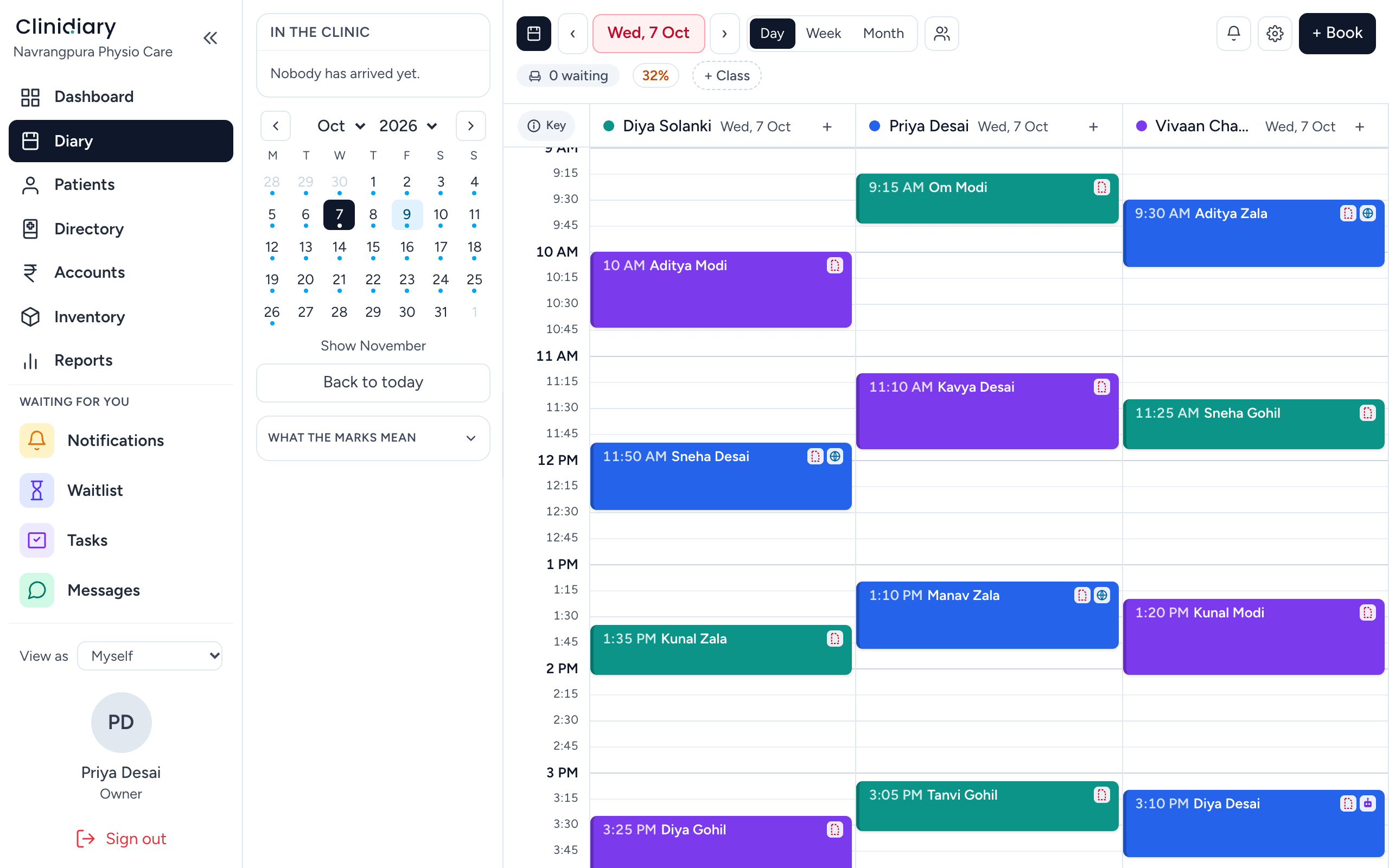
- Appointments. Every doctor and therapist side by side in one diary, by day, week or month, with repeat bookings checked for clashes before they are saved.
- Online booking. A booking page for your clinic that only offers times you are open, and only the services you choose to show.
- Consultation and therapy notes. Ayurvedic templates that save themselves while you type and lock once signed.
- GST bills and payments. Consultation, therapies and medicines on one bill, with your GSTIN, and cash, UPI and card on a day end that balances.
- Packages. A Panchakarma course sold up front and counted down visit by visit.
- WhatsApp reminders. Each day's reminders written for you and ready to send. See how WhatsApp reminders work.
- Staff, stock and reports. Attendance and leave for doctors, therapists and the front desk, medicines and oils on the shelf, and the numbers that tell you how the clinic is doing.
Set up for Ayurveda from the day you sign up
A lot of clinic software in India was built for an allopathic OPD: a queue, vitals, a diagnosis and a prescription. An Ayurvedic consultation does not fit that screen. Choose Ayurveda as your profession when you sign up for Clinidiary, and the clinic starts with these visit types:
| Visit type | Length | Starting price |
|---|---|---|
| Ayurvedic consultation | 30 minutes | ₹500 |
| Follow-up consultation | 15 minutes | ₹300 |
| Abhyanga | 60 minutes | ₹1,500 |
| Shirodhara | 45 minutes | ₹2,000 |
| Kati basti | 30 minutes | ₹1,200 |
| Panchakarma therapy | 90 minutes | ₹2,500 |
| Nasya | 30 minutes | ₹800 |
These are starting points. Change the names, lengths and prices to your own, and add the therapies you offer that are not on the list.
It also comes with two note templates:
- Ayurvedic consultation. Chief complaints (pradhana vedana), history of the present illness, past illness and treatment, family history, diet and daily routine (ahara, vihara) and current medicines. Then prakriti, from Vata, Pitta and Kapha to their combinations and Sama; vikriti; agni (Sama, Vishama, Tikshna or Manda); koshtha (Mridu, Madhyama or Krura); and bala. The ashtavidha pariksha has a line each for nadi, mutra, mala, jihva, shabda, sparsha, drik and akriti. It ends with roga nidana, the line of treatment (shamana, shodhana or both), medicines with dose, time and anupana, the therapies planned, pathya-apathya advice and the follow-up.
- Panchakarma or therapy session. The therapy, chosen from Abhyanga, Swedana, Shirodhara, Nasya, Basti, Virechana, Vamana, Kati basti, Janu basti, Pizhichil, Udvartana or other; the day of the course, such as 3 of 7; the oil, decoction or medicine used; the duration; observations; how the patient responded; and advice until the next session.
Both can be edited to match your own case sheet, and you can design your own templates from a blank page. Notes already written keep the layout they were made with. When you set up the practice, the registration number it asks for is labelled State Board of Indian Medicine registration number.
Panchakarma courses, session by session
A Panchakarma course is three things at once: a package the patient pays for, a run of daily bookings with a therapist, and a short note for every session. Clinidiary handles each part with tools that are already there:
- The package. Set up each course you sell, say "Panchakarma, 7 days", with its number of sessions, its price, how long it is valid and the services it covers. The patient pays once, by cash, UPI or card, and each session is drawn from the package as it is billed, so nobody is charged twice. See how packages work.
- The bookings. Book the whole course in one go as repeat bookings, with every date checked for clashes before anything is saved.
- The session notes. The therapist or doctor writes a short Panchakarma session note for each day, on the same patient file as the consultation that planned the course.
The patient's file shows how many sessions are used and how many are left, at any branch of your practice.
Medicines at the counter
Most Ayurvedic clinics dispense their own medicines: churnas, kashayas, arishtas, vatis, tailas and ghritas. In Clinidiary you add each one you stock as an item, once, with its price, its GST rate and its HSN code. After that the front desk adds it to the patient's bill beside the consultation, and it comes off that branch's stock. One bill, one payment.
Healthcare services by a registered practitioner are generally exempt from GST, while the medicines and oils you sell carry GST at their own rate. A new service in Clinidiary starts GST-exempt, and a GST-registered clinic's bill with no tax on it is headed "Bill of supply". Which of your services and products are taxable is a question for your CA. See how GST bills work in Clinidiary and how stock works.
What Clinidiary does not do
We would rather you know before you sign up than find out in your second week:
- No built-in Ayurvedic medicine database or formulary. Clinidiary does not come with a list of classical or proprietary medicines. You add the ones you stock yourself, with your own names and prices.
- No pharmacy or manufacturing batch production. It sells and counts the medicines on your shelf. It does not prepare batches, track raw herbs, or record batch numbers and expiry dates.
- No insurance claim filing. A patient can be marked as having Mediclaim, and a bill can be shared as a link for the patient to send to their insurer or TPA, but Clinidiary does not file claims.
Your data stays in India
Indian clinics' records are hosted in Mumbai, on a server that holds Indian clinics only. Every connection is encrypted, sign-in can use a passkey or two-factor code, screens lock themselves when you step away, and every record keeps a trail of who did what. A front desk login books, bills and takes payments, and cannot open clinical notes.
India's DPDP Act asks clinics to protect patient data and to know what they would do if something went wrong. Our guide to patient data security and the DPDP Act explains what that means for a clinic in plain words.
What it costs
Clinidiary is free for the first six months, with every feature for running your clinic, starting with just your email and no card details. After that it is ₹699 a month for each doctor, plus GST, paid monthly with no contract, so you can cancel any time. Therapists, owners, managers, receptionists and accounts staff are free, so a clinic with two doctors, three therapists and a front desk pays for the two doctors: ₹1,398 a month. A Panchakarma centre is priced the same way: three doctors and eight therapists pay ₹2,097 a month.
Paying ahead for a year or more is available on request.
There is no separate charge for WhatsApp reminders, online booking or packages. See Ayurvedic clinic software price in India for what it comes to for a solo vaidya, a clinic with several doctors and a Panchakarma centre.
One clinic or many branches
If you run a consultation clinic in town and a Panchakarma centre elsewhere, every branch has its own address, phone, opening hours and online booking link, but patients, staff and reports stay in one place. A patient who sees the vaidya at one branch and has their therapies at the other has one file, and their course counts down wherever they are treated. Read clinic management software for multi-branch Ayurvedic practices for how that works.
Moving from a register, Excel or other software
You can bring your patient list in yourself from an Excel or CSV file. Clinidiary reads the column headings, shows you exactly what will happen, and you load it with one more click. Our guide to moving your clinic from paper or Excel walks through it, step by step, and our team helps with the export from the software you are leaving.
How to choose
If you are comparing options, these guides will help:
- Best Ayurvedic clinic management software in India (2026) explains the kinds of software Ayurvedic clinics choose between, and what to test first.
- Ayurveda practice management software in India: 2026 buyer's guide gives you the questions to ask any vendor before you pay.
- Best Ayurveda software in India helps you choose by the kind of practice you run, and the best PMS for an Ayurvedic clinic explains what a practice management system must do.
- India's No. 1 Ayurveda practice management software? gives ten tests to judge any such claim, ours included.
Frequently asked questions
What is the best Ayurvedic clinic software in India?
No independent ranking exists, so the best one is the one that fits how your clinic works. For most Ayurvedic clinics in India that means notes that hold an Ayurvedic consultation, Panchakarma courses sold as packages, medicines on the same GST bill, UPI, WhatsApp reminders and a fair price per doctor. Clinidiary does these and is free for six months, so you can run your own clinic on it before deciding.
Does Clinidiary include a list of Ayurvedic medicines?
No. There is no built-in medicine database or formulary. You add the medicines you stock as items, once, with your own names, prices, GST rates and HSN codes. After that they go on the bill in a tap and come off your stock.
Can I change the Ayurvedic note templates?
Yes. The Ayurvedic consultation and Panchakarma session templates are starting points. You can add, remove or rename sections and questions, or design your own templates from a blank page. Notes already written keep the layout they were made with.
Do I pay for my Panchakarma therapists?
No. Therapists are free, and so are owners, managers, reception and accounts staff. You pay ₹699 a month, plus GST, for each doctor, wherever they work.
Is there free Ayurveda software in India?
Clinidiary is free for the first six months with every feature for running your clinic, starting with just your email and no card details. After that it is ₹699 a month for each doctor, plus GST, with therapists and the front desk free and no contract.
Is my patients' data safe?
Indian clinics' data is hosted in Mumbai. Connections are encrypted, sign-in can use passkeys or two-factor codes, screens lock themselves when left alone, and every action is recorded in an audit trail.